 Save
Save I still remember the first time I attempted an elaborate charcuterie board at a dinner party—I thought I'd just toss some cheese and meat on a board and call it a day. But watching my guests lean in closer, their eyes lighting up as they discovered each carefully placed element, I realized this wasn't just food. It was an edible canvas, a conversation starter, a moment of luxury made tangible. That's when I became obsessed with the art of the artisan board, learning to fold, sculpt, and compose like a chef painting a plate. The Advanced Artisan Array is the culmination of those lessons—a show-stopping creation that transforms simple ingredients into something truly memorable.
I'll never forget hosting my sister's engagement celebration and spending an entire morning sculpting cheese roses with my hands, my back aching but my heart so full. When she walked into that dining room and saw the board—the colors, the textures, the sheer abundance—she teared up. She said it looked too beautiful to eat. Of course, we ate every last bite, but that moment taught me that a board like this becomes more than sustenance; it becomes a memory, a gift, a declaration that you care enough to create something extraordinary.
Ingredients
- Prosciutto, soppressata, capicola, chorizo, and mortadella: Each cured meat brings its own personality—the delicate sweetness of prosciutto, the spicy depth of soppressata—and slicing them thin enough to fold elegantly creates a silky texture that melts on the tongue.
- Brie, manchego, aged cheddar, goat cheese, gouda, and provolone: This mix of soft, semi-firm, and hard cheeses gives your board complexity and ensures every taste preference is honored; the provolone is your secret weapon for sculpting, so choose one that's pliable but not too soft.
- Red and green grapes, figs, pomegranate, apple, and pear: Fresh fruit cuts through the richness of the meats and cheeses with bright acidity and natural sweetness—slice apples and pears just before serving to prevent browning.
- Dried apricots, cherries, and figs, plus Marcona almonds and pistachios: These add pockets of concentrated flavor and textural contrast; the nuttiness grounds the entire board and gives your guests something to nibble between bites of richer elements.
- Cornichons, mixed olives, roasted red peppers, and artichoke hearts: These pickled and brined elements are the secret stars—they awaken the palate and provide brightness that prevents the board from feeling one-dimensional.
- Whole grain mustard, fig jam, and honey: These are your flavor bridges, the condiments that tie everything together and let your guests customize each bite to their preference.
- Baguette, assorted crackers, and grissini: Offer variety in texture and grain; some guests will want a sturdy base for their cheese, others will prefer the delicate crispness of grissini.
- Fresh rosemary, thyme, edible flowers, microgreens, and radish roses: These garnishes are the final brushstrokes—they transform a good board into a work of art and signal that no detail has been overlooked.
Tired of Takeout? 🥡
Get 10 meals you can make faster than delivery arrives. Seriously.
One email. No spam. Unsubscribe anytime.
Instructions
- Prepare your canvas:
- Start with a pristine wooden or marble board—this is your stage. Wipe it clean and set out small bowls for your jams, honey, and pickles in strategic locations around the perimeter. These will anchor your board visually and provide practical resting spots for condiments.
- Sculpt your cheese roses:
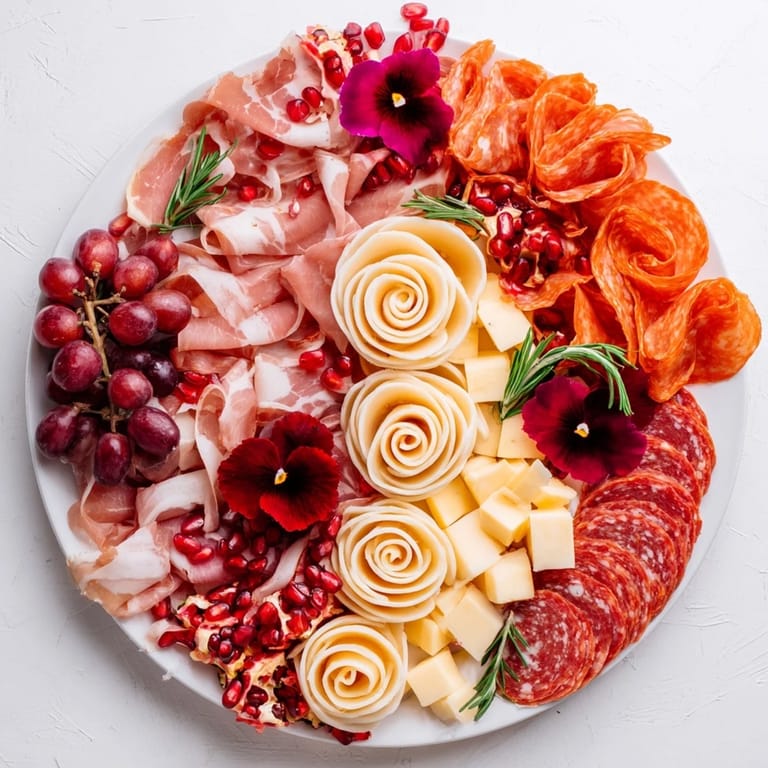
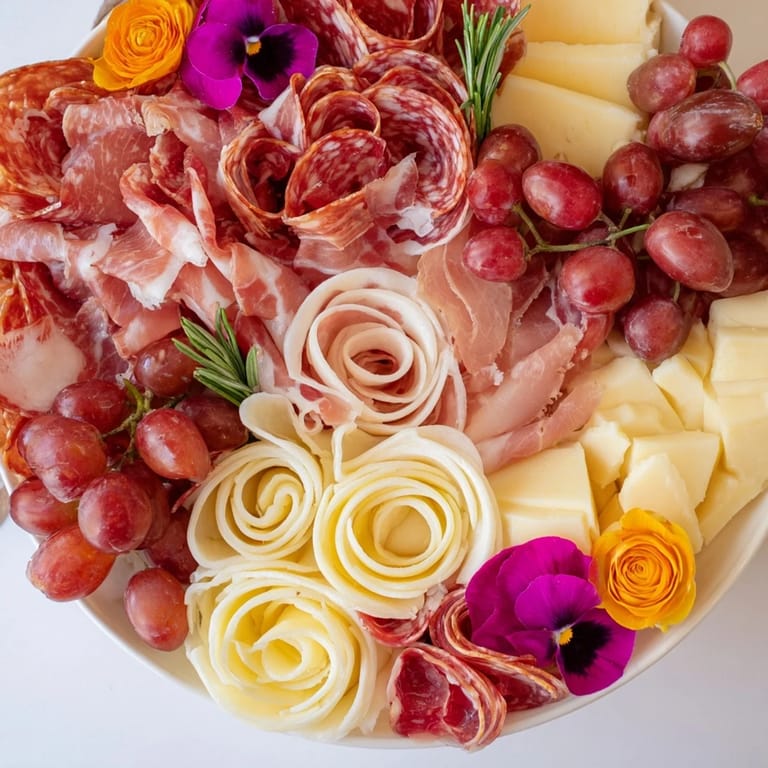
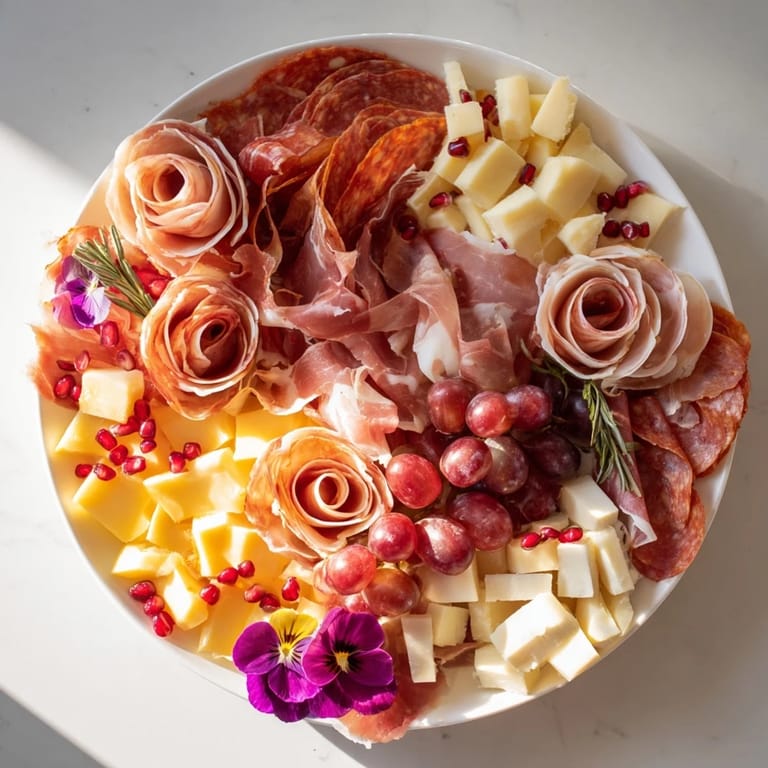
- This is where patience becomes art. Take thin slices of provolone and, working gently, roll each slice into a tight spiral starting from one end. Once rolled, carefully fan out the outer edge with your fingertips to create petal-like layers. It might take a few tries to get the hang of it, but once you do, you'll find it almost meditative. Create at least five or six roses to scatter throughout the board.
- Create meat roses for drama:
- Using your most delicate cured meats like prosciutto or capicola, repeat the rose-sculpting technique. These will be more fragile than cheese roses, so handle them with care and position them where they won't be jostled.
- Fold and layer your cured meats:
- This is where the board becomes luxurious. Don't lay meats flat; instead, fold them into loose, organic shapes and layer them so they overlap with movement. Think of it like creating gentle waves across the board. Fill gaps completely—a crowded board is a maximalist board, and that's the whole point here.
- Cut and arrange your cheeses:
- Vary your cuts—wedges for the hard cheeses, cubes for the semi-firm, and shards for dramatic presentation. Place your sculpted cheese roses among the cut pieces, and tuck wedges into nooks where they'll catch the light.
- Cluster your fruits strategically:
- Group fresh fruits by color and type, creating visual pockets of brightness. Nestle dried fruits alongside fresh ones to show the contrast. This creates a sense of abundance without looking chaotic.
- Distribute nuts, olives, and pickles:
- Use small piles and clusters rather than spreading everything thin. Place olives in a small bowl or scattered in a concentrated area. Let cornichons gather in one spot, artichokes in another. This creates visual rhythm and makes it easier for guests to serve themselves.
- Arrange your breads with intention:
- Fan out baguette slices in overlapping rows. Position crackers and grissini in the remaining gaps, creating lines and patterns that guide the eye across the board.
- Crown it with garnishes:
- This is your final moment of creativity. Tuck fresh rosemary sprigs and thyme between ingredients. Scatter microgreens where they'll catch light. Place radish roses as jewel-like accents. Add edible flowers as the ultimate flourish—they signal that this is a board made with intention and joy.
- Present with confidence:
- Serve immediately if your guests are waiting, or cover loosely with plastic wrap and refrigerate until you're ready to showcase your creation. Either way, step back and admire your work before anyone takes a bite.
 Save
Save Years ago, I made a board like this for my best friend who had just moved into her first home. She stood in her empty dining room surrounded by boxes, and we sat on the floor with that board between us, eating directly from the marble and laughing until our faces hurt. That's when I understood that these boards aren't really about impressing people with technique—they're about creating a moment where everyone feels seen, celebrated, and nourished in the deepest way.
The Art of Abundance
There's a philosophy behind maximalist charcuterie that took me years to understand. It's not about having the most expensive ingredients or the rarest cheeses—it's about creating an experience of generosity and possibility. When your guests approach a board like this, they're not just choosing what to eat; they're choosing their own adventure. One person might create a perfect triangle of brie with fig jam and a candied almond. Another might discover they love the combination of aged cheddar with cornichon and roasted red pepper. Your job as the board curator is to make every combination feel intentional and delicious.
Building Your Flavor Story
Think of your board as a narrative with a beginning, middle, and end. Start with the lighter, more delicate flavors—fresh fruits, creamy cheeses, mild cured meats. Move through the middle with deeper, more complex tastes—aged cheeses, spiced meats, pickled vegetables. Finish with the bold accents—nuts, intense mustard, rich honey. This flow ensures that no single element overwhelms the palate, and guests naturally progress through a tasting journey whether they intend to or not. The beauty of this approach is that it feels effortless to the people enjoying it, while revealing the careful thought you invested.
Making It Your Own
The Advanced Artisan Array is a template, not a mandate. I've learned that the best boards are the ones that reflect your personality and what you have access to. If you love smoked cheeses, lean into them. If you can find candied nuts, they're worth every penny of indulgence. If edible flowers feel like overkill to you, skip them and focus on herb garnishes instead. The most important ingredient isn't on any list—it's the care you put into every detail.
- Substitute any cured meat or cheese with versions you adore or that reflect your budget and access.
- Add unexpected elements like dark chocolate truffles, spiced nuts, or marinated mushrooms for your unique spin.
- Consider your guests' dietary needs and add plant-based alternatives without apology—a vegan brie and some cured vegetables belong on this board just as much as prosciutto.
 Save
Save At the end of the day, the most advanced thing about this board is the generosity it represents. You're saying yes to abundance, yes to beauty, yes to the idea that feeding people well—and feeding their eyes as well as their bellies—matters.
Recipe Guide
- → How do I sculpt cheese roses?
Use pliable cheeses like provolone sliced thinly. Roll slices into tight spirals and gently fan out the edges to mimic petals for a delicate floral look.
- → What meats work best for folding and layering?
Cured meats such as prosciutto, soppressata, capicola, and chorizo fold beautifully to create elegant ribbons and curled shapes that add depth and interest.
- → How should fresh and dried fruits be arranged?
Group fruits in clusters combining colors and shapes, such as grapes, figs, pomegranate, and dried apricots, to create visual contrast and texture.
- → Which garnishes enhance the board’s appearance?
Fresh herbs like rosemary and thyme, edible flowers, microgreens, and radish roses add vibrant color and a refined finishing touch.
- → Can I substitute any components for dietary needs?
Yes, gluten-free crackers or plant-based meats and cheeses can be used to accommodate dietary preferences while maintaining the board’s style.
- → What tools aid in assembling this board?
A large wooden or marble board, cheese knives, spreaders, small bowls, spoons, a paring knife for sculpting, and food-safe gloves assist in intricate assembly.